Who Was Pastor Russell?
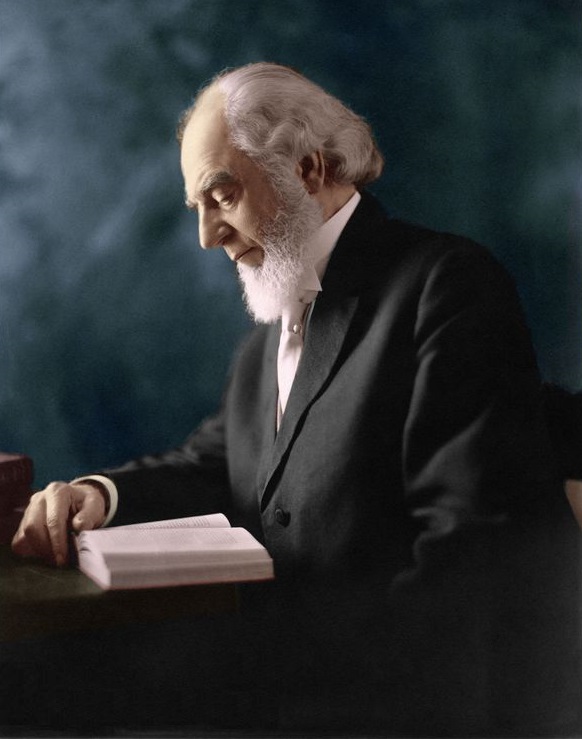
Charles Taze Russell (February 16, 1852 – October 31, 1916), commonly known as Pastor Russell, was an American Bible preacher, editor, publisher, and founder of the Bible Student movement.
Early Years
Charles Russell was born in Allegheny, Pennsylvania (now part of Pittsburgh) to a Scotch-Irish Presbyterian family. His mother died when he was nine. By the age of twelve, he was helping his father run a haberdashery business and writing contracts for customers.
At thirteen, he left the Presbyterian Church for the Congregational Church. Three years later, in 1868, he experienced a crisis of faith – the doctrines of eternal torment seemed irreconcilable with a God of love. He began to doubt God's very existence.
Return to Faith
In 1870, at age eighteen, he attended a lecture by Adventist Jonas Wendell. The meeting renewed his faith in the Bible as the Word of God and inspired him to systematically study the Scriptures. Together with his father, he established a Bible study group that concluded doctrines such as the Trinity and hellfire lacked Scriptural support. Of particular significance to him was the teaching of Christ's second coming – he became convinced that it would not be a visible, spectacular event, but an invisible presence (Greek: parousia), marking a new epoch in God's plan of salvation. This teaching became one of the foundations of his later work and profoundly shaped the entire Bible Student movement.
Collaboration with Barbour
In January 1876, Pastor Russell received a copy of Herald of the Morning, a journal published by Nelson H. Barbour of Rochester, New York. Barbour taught that Christ had returned invisibly in 1874. Pastor Russell visited Barbour and began collaborating with him – becoming assistant editor of Herald of the Morning and co-funding the book Three Worlds and the Harvest of This World (1877).
In 1878, Barbour published an article that practically repudiated the ransom doctrine – the central teaching about Christ's redemptive death. Pastor Russell firmly opposed this. The difference of views on this crucial matter led to their separation.
Zion's Watch Tower
In July 1879, Pastor Russell published the first issue of Zion's Watch Tower and Herald of Christ's Presence – the journal he would edit until his death. He was its editor, chief author, and publisher. Subscription cost 50 cents per year, and the journal was freely sent to those who could not afford it.
In 1881, Pastor Russell co-founded the Zion's Watch Tower Tract Society (from 1896, Watch Tower Bible and Tract Society), and in 1884 became its president after formal incorporation.
Studies in the Scriptures
Between 1886 and 1904, Pastor Russell published six volumes of the Millennial Dawn series (later renamed Studies in the Scriptures):
- The Divine Plan of the Ages (1886)
- The Time Is at Hand (1889)
- Thy Kingdom Come (1891)
- The Day of Vengeance (1897)
- The At-one-ment Between God and Men (1899)
- The New Creation (1904)
Nearly 20 million copies were distributed worldwide during Pastor Russell's lifetime. In 1910, a secular journal calculated that Pastor Russell's writings were the third most widely circulated on earth – after the Bible and the Chinese Almanac.
Activities
Pastor Russell maintained an extraordinarily active ministry:
- He delivered public lectures in numerous cities across North America, Europe, the Middle East, and other regions of the world.
- His sermons were published in over 2,000 newspapers.
- In 1908, he relocated the Society's headquarters to Brooklyn, New York.
- In 1914, he produced the Photo-Drama of Creation – an eight-hour synchronized sound film, one of the first of its kind in the world.
Death
Pastor Russell died on October 31, 1916, at age 64, on a train near Pampa, Texas, while returning from a lecture tour to Brooklyn. He was buried at the cemetery in Ross Township, Pennsylvania.
After Pastor Russell's Death
Following Pastor Russell's death, Joseph F. Rutherford became president of the Watch Tower Bible and Tract Society. His management style and doctrinal changes provoked disputes, resulting in a significant number of Bible Students leaving the organization by 1931. Several independent groups formed that continued studying Pastor Russell's writings.